TIETO26 Exercise – National Preparedness for the Information Society
TIETO is Finland’s largest joint exercise bringing together companies and public authorities to strengthen cooperation and information sharing in the face of large-scale hybrid, cyber, and information disruptions. It also serves as a cross-sectoral exercise that helps companies enhance business continuity management, preparedness, and crisis communication capabilities in complex disruption scenarios.
The TIETO26 Exercise – Strengthening the Resilience of the Digital Society
The TIETO26 Exercise – Strengthening the Resilience of the Digital Society
The functioning of society’s security-of-supply–critical operations and public communications depends on the companies that provide essential services and on their information systems. Broad-spectrum influence operations—encompassing cyberattacks, disinformation campaigns, and physical actions—can undermine societal resilience and, at their most severe, endanger the safety of citizens. Preparing a digital society requires close and seamless cooperation between companies, their customers, partners, and public authorities.
TIETO26 challenges companies with successive disruption scenarios and familiarizes them with joint practices developed together with authorities to support the restoration of operational capacity. Participating companies gain hands-on experience in information exchange across sectors and deepen their understanding of situational awareness as a cornerstone of disruption management. The exercise is a scenario-driven, strategic-level program conducted in four phases during 2026–2027.
A wide range of industries will participate, including key service providers from the telecommunications and ICT, security, and media sectors. Authorities responsible for these domains are also involved, alongside the National Emergency Supply Agency, the Finnish Transport and Communications Agency’s National Cyber Security Centre, the Defence Forces, the Police, the Finnish Broadcasting Company Yle, and many other critical actors.
The previous TIETO24 exercise brought together as many as 850 designated participants from over 170 real-world organizations. TIETO26 aims to once again gather a large and diverse group of participants to train in these crucial areas of information exchange and societal resilience.
Supporting Continuity, Preparedness, and Cooperation through Training
The TIETO26 exercise is designed to strengthen business continuity management, preparedness, and contractual cooperation between companies and authorities. Its goal is to foster a culture of collaboration and to develop joint operational models. At the same time, it identifies concrete needs for improving cyber incident response, which will be integrated into the daily practices of participating companies and, for example, into the National Emergency Supply Agency’s Digital Security 2030 development program.
Our strength lies in the expertise of companies responsible for critical functions, combined with the ability of authorities to reinforce companies’ operational capacity during crises through situational data, guidelines, and expert support. Together, serious disruptions can be detected more quickly, situational awareness can be established faster, and the ability to mitigate the impact of incidents and return to normal operations is enhanced. Close cooperation between companies also allows authorities to target their support more effectively in large-scale disruptions that affect multiple organizations.
The TIETO26 exercise is organized by the Digipool of the National Emergency Supply Organization in cooperation with the National Emergency Supply Agency (NESA), the Finnish Transport and Communications Agency’s National Cyber Security Centre (Traficom NCSC-FI), the Police, and the Defence Forces. The National Emergency Supply Agency is responsible for execution. TIETO exercises have been held in various formats every two years since the late 1970s, originally led by the Defence Forces. Since 2018, responsibility has rested with the National Emergency Supply Agency.
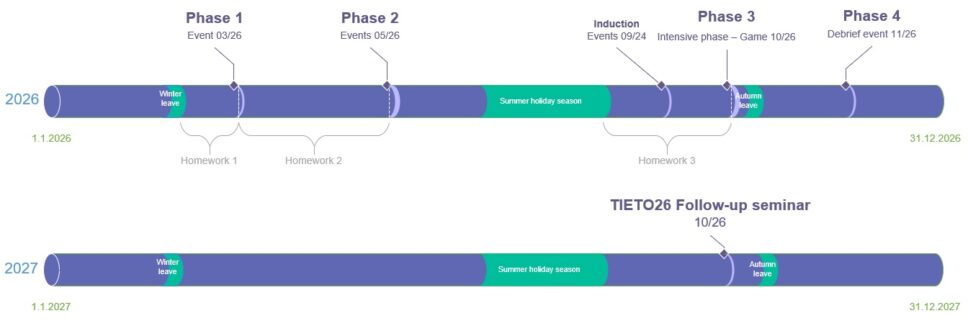
The exercise consists of four phases. The first two are structured as seminars, providing participants with up-to-date knowledge and practical insights into operating under disruption conditions.
The content of Phases 1 and 2 highlights themes that should be reflected in companies’ continuity plans when preparing for crises and disruptions: crisis team operating models, crisis communication, contractual preparedness, collaboration with third parties, as well as other current preparedness topics. These also include authorities’ needs and expectations for cooperation, along with updates on relevant legislative changes.
Participants of TIETO24 Exercise
Phase 3 consists of the so-called Intensive phase, a three-day live two-sided role-play exercise. In this phase, companies’ crisis management teams operate and make decisions based on the situational awareness they build. The teams are trained in comprehensive information sharing in its different forms – from subcontractors to customers, and all the way to the public sector actors. With accurate situational awareness, it becomes possible to make the right decisions to navigate through a crisis.
Schedule of the TIETO26 Exercise
Phase 1: Training session in March
Phase 2: Training days in May
Phase 3: Intensive Stage – Orientation days in September
Phase 3: Intensive Stage / Simulation exercise in October
Phase 4: Debrief day in November
Phase 4: Follow-up seminar about one year after the Intensive Stage, in October 2027
TIETO26 Schedule
What Participants Gain from the Exercise
Participating organizations receive valuable benefits that help ensure business continuity even during disruptions.
The exercise provides free training for organizational staff – building skills that truly matter.
Security of supply is partly guaranteed through trusted networks; therefore, the networking opportunities offered by the exercise bring significant value for managing crises.
More broadly, the exercise equips participants with practical tools, knowledge, materials, and frameworks to strengthen their own organizational resilience.
In general, the exercise provides participants with tools, knowledge, materials, and a solid foundation to strengthen their organization’s operations. Based on the lessons learned and experiences gained, organizations will prepare or update their contingency and continuity plans and agreements.
By practicing together, participants create harmonized and agile operating models, which are then tested and further developed in practice. Cooperation with authorities is improved, taking into account the specific characteristics of disruptive situations, while also learning how to leverage networks to ensure business continuity.
Participants also gain the capability to organize their own cyber incident exercises. Ultimately, the exercise provides a strong basis for making informed investments in preparedness.
Participants of the TIETO26 Exercise
Participants of the TIETO26 Exercise
The TIETO exercise brings together a “miniature society” to practice resilience, with the core formed by the sectors and industry pools of the National Emergency Supply Organization (NESO). This time, special attention is placed on food supply chains, meaning the organizations of NESO’s Food Supply Sector as well as those from other closely connected industries. Ensuring the continuity of food supply has been identified as a critical preparedness priority, and the TIETO exercise will actively contribute to this effort.
Because food sector operations are highly digitalized, they carry significant interdependencies and multiple potential threat vectors. The exercise scenarios will be built around these themes, creating impacts that are relevant to participants regardless of their sector.
In addition, companies from other security-of-supply–critical industries will participate, including major telecommunications and ICT providers, security companies, and the media sector. Sector-specific authorities will also be involved, alongside the National Emergency Supply Agency, the Finnish Transport and Communications Agency’s National Cyber Security Centre (Traficom NCSC-FI), the Police, and the Defence Forces.