
From pharmaceutical plants to ports – Elomatic’s solutions strengthen comprehensive security
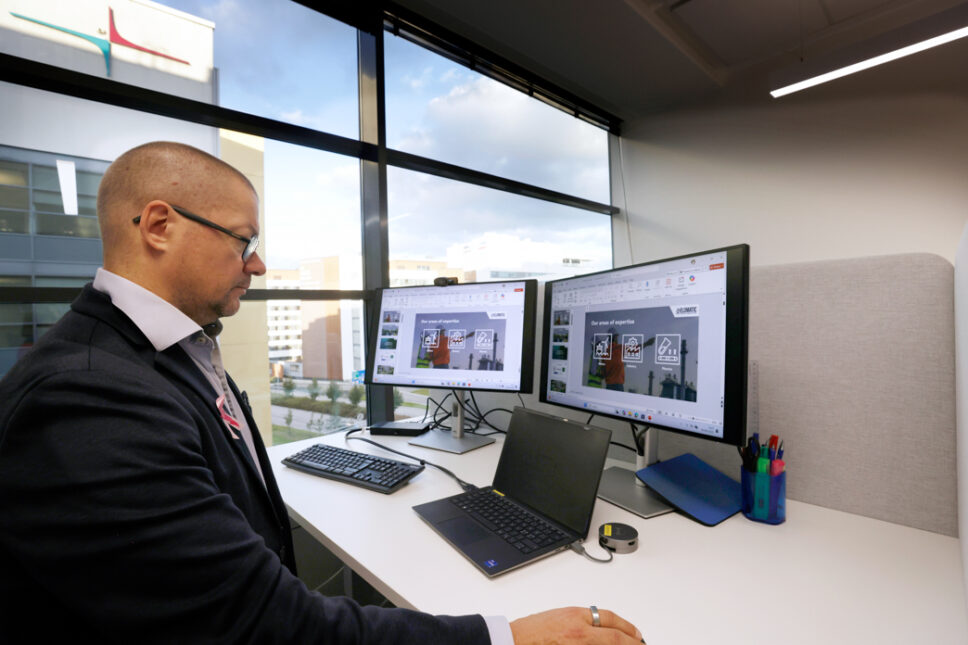
As the world has become increasingly uncertain, dual-use technologies have become a more important part of the comprehensive security of both companies and society. At Elomatic, dual-use thinking has already become a part of routine collaboration with clients. “Without high-level expertise and strong partners, it is impossible to design dual-use products.”
Pharmaceuticals, maritime industries, energy, industrial production. Engineering and consulting company Elomatic serves sectors whose importance for security of supply and comprehensive security cannot be overlooked. The company has therefore spent considerable time considering what dual-use technologies mean for it in practice.
In public discussion, dual-use is often simplified to mean that the same equipment can be used in both civilian and military environments. At Elomatic, the concept is viewed more broadly.
“Many dual-use issues originate from client needs, so we work on them together with clients. We understand that dual-use solutions are an important part of society’s overall security and resilience,” says Teemu Turunen, Business Development Director at Elomatic.
• Dual-use products are civilian physical products, software, technologies or services that can also be used for military purposes.
• Examples include drones, various chemicals and positioning software. In civilian use, dual-use products can improve quality of life or increase production efficiency.
• The importance of dual-use products has grown significantly in recent years as the geopolitical operating environment has become increasingly unpredictable.
Examples are easy to find. Elomatic supplies cleanrooms to the pharmaceutical industry that could equally be used in semiconductor manufacturing. Semiconductors, in turn, are increasingly important in future energy solutions. They are also needed in advanced digital tools that help safeguard society’s critical infrastructure.
“In the maritime industry, icebreakers are now highly versatile operational platforms. In addition to icebreaking, they can monitor the environment and collect data – there are countless possibilities.”
Simplicity can also be versatile
In the energy industry, the dual-use perspective emerges through energy’s central role in overall security. Society only functions when the energy system functions. At the same time, energy is a key factor in climate change and the most important prerequisite for industrial activity.
“Dual-use in energy can be viewed through processes. Production can be optimised to run as smoothly as possible, while another lever can be used to optimise energy consumption, which in turn affects production,” says Turunen.
Even something as simple as a thermal energy storage facility can serve as an example.
“It can stabilise production by reducing consumption peaks and provide benefits through that. At the same time, it can become a valuable asset for electricity markets externally. The need determines the use, even if it is the same unit, component or tool.”
Finland’s infrastructure can and should also be viewed from a dual-use perspective. This is especially important in the case of ports, as 95 per cent of Finland’s goods transport passes through them.
“From the perspective of security of supply, ports are absolutely critical. They are also central to offshore wind power construction, which requires specialised capabilities such as sufficiently deep water, which not all ports have. When ports are developed for the needs of offshore wind power, their security-of- supply capability also improves. It makes no difference whether they are being used to transport a wind turbine blade or nacelle – or a tank,” says Turunen.
“The need determines the use, even if it is the same unit, component or tool.”
Elomatic has developed the Float Foundation concept, which reduces the need for specialised installation vessels in offshore wind power construction. However, the concept is not limited to renewable energy applications.
“We are constantly developing new applications. In a crisis situation, for example, it could be used as an emergency harbour or to increase berthing capacity. Deployment would be fast because the structure can simply be towed into place and anchored without construction work.”
The bigger picture must be understood
Designers require new tools to work on dual-use solutions. Elomatic has also noticed this.
“We need to think more comprehensively about overall security and dual-use solutions and help clients understand the benefits and opportunities they create,” says Teemu Turunen.
According to Turunen, this new type of systemic thinking is not learned in a classroom – it comes through experience. As a result, expertise in this area is in high demand. At the same time, dual-use technologies make product development extremely interesting and create attractive job opportunities.
Turunen says that he personally learned systemic thinking through Elomatic’s international expansion. The company has secured its first major maritime industry contracts in Germany and Canada. They are based on strong Finnish engineering expertise.
Another important factor is partnerships.
“In a rapidly changing world, all the expertise you need cannot be found in just one place. Today’s environment requires good partners,” Turunen sums up. This applies equally to companies and societies.
Turunen praises the ability of Finnish businesses and political leadership to understand the bigger picture. The challenge, however, is the limited influence of a small country. Even so, Turunen believes Finland has every opportunity to succeed in an unstable world. The country has world-class expertise in sectors critical to comprehensive security, as well as a clear understanding of the situation. What is needed is agility. Denmark, for example, has established a foothold in many places where a country of its size is not usually seen.
“Agility and speed are extremely important today. At the same time, countries need to recognise their own strengths instead of simply copying what neighbouring countries have already done,” Teemu Turunen reminds.
Teemu Turunen’s recommendations for smart preparedness
- Honestly and systematically identify the current situation: A realistic assessment of current preparedness forms the basis for all further development. Organisations should invest in this and systematically gather insights across the organisation.
- Extend preparedness thinking towards continuity management: In many cases, preparedness focuses mainly on risk assessment, but it is equally important to consider how organisations operate during an actual crisis and how recovery can be managed as efficiently as possible. Plans and related exercises should focus at least on the most significant risks to the business.
- Recognise the opportunities created through preparedness: When planning and selecting preparedness measures, it is important to identify their potential “dual-use” value. Measures that enable rapid recovery from crises can increase business flexibility and create new opportunities.
Text: Harri Junttila
Photos: Liisa Takala