
An ambitious ETS can strengthen European competitiveness

The Commission’s Emissions Trading System (ETS) proposal maintains the pathway towards decarbonisation by 2050 but risks slowing down industrial renewal in Europe. Co-legislators should keep the supply of allowances in check to enable frontrunner investments in decarbonisation.
In her State of the European Union speech, President Ursula von der Leyen correctly noted that our dependence on fossil fuels has led to over 90 billion euros in additional costs, “without a single molecule of energy added”. A large part of that amount flowed outside of Europe. She also set out the alternative: an electrified Europe that could cut the fossil fuel import bill by 260 billion euros a year.
She also reiterated her support for the EU’s climate targets, which are the basis for flagship energy and climate legislation of this mandate: namely, the revision of the EU Emissions Trading System, which the Commission adopted in mid-July this year.
It’s not just the destination that matters
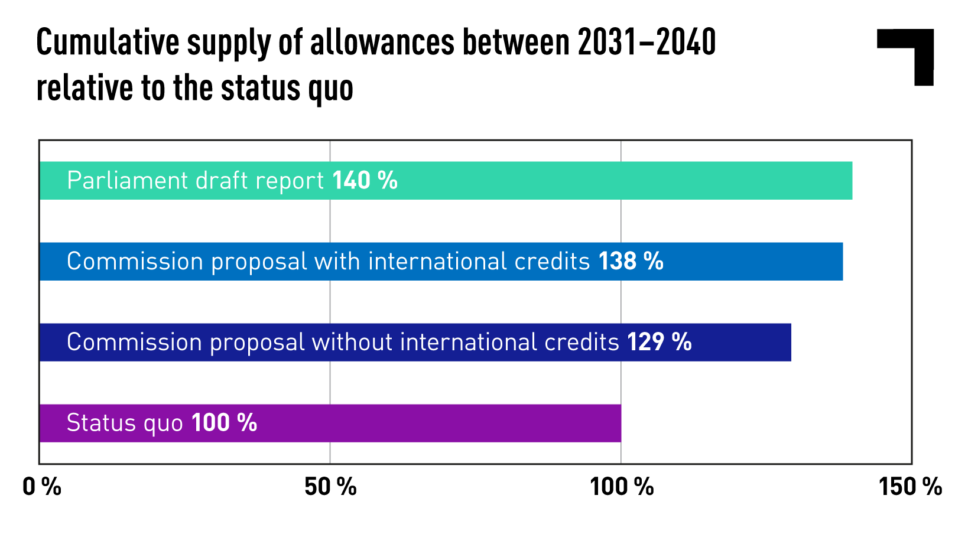
The Commission’s proposal does indeed align the ETS with the EU’s emission reduction target. But in addition to the destination, the journey there matters: the Commission’s proposal and the alternative option included in the Parliament’s draft report would increase the volume of allowances released by roughly 30–40 percent between 2030 and 2040. Furthermore, free allocation would continue for several years longer. These changes would weaken the incentives for the deployment of clean technologies in Europe.
In practice, a significantly less ambitious trajectory for cutting emissions would affect European companies investing in the development of clean technologies and production of near-zero emissions materials. Manufacturers like Metso, Andritz and Valmet provide state-of-the art solutions for industrial processes such as clean steelmaking and hydrogen production. Metal producers such as SSAB, Outokumpu and Boliden offer low-carbon metals for customers globally, with plans to go even further. Furthermore, all of this is supported by a strong grid technology sector, whose ranks include companies like ABB and Prysmian.
In many of these sectors, European companies remain global leaders and the EU, with ambitious policies like the ETS, has built an excellent environment for deploying their technologies. A large number of countries and regions are following Europe’s example, with the share of global emissions covered by carbon pricing on the rise.
The IEA estimates the global market for clean technologies to grow rapidly from the current 1.2 trillion to 2–5 trillion USD by 2035. There is also significant untapped potential in the market for near-zero emissions materials such as clean steel, that will, according to the IEA, remain unrealised without a strong policy push.
Taking a giant leap requires trust
To take the next step in decarbonisation, gradual change is not enough: we need frontrunner investments in ground-breaking technologies, such as steelmaking based on clean electricity and hydrogen.
Trust in the system is crucial for turning plans into reality: the ETS works not only because it encourages companies to cut emissions here and now but also in the long run. That helps companies plan long-term and make investments in innovative new technologies instead of only making their existing processes more efficient.
Keeping the increase in in the volume of released allowances more modest than in the Commission’s proposal is important for securing that trust. Similarly, sticking to the previously agreed timeline for phasing out free allocation is crucial.
Putting revenues to work
The ETS does come with costs. But unlike the money spent on imported fossil fuels, ETS revenues stay in the coffers of the EU and the Member States. Yet only around 5 percent of them are currently channelled back to industry to speed up decarbonisation. This needs to change: smarter use of the revenues and free allocation can help kickstart the switch to clean steelmaking, fuels and feedstocks.
The need to develop and tune the EU ETS has been part and parcel of the journey from the beginning. The revision of the ETS is an opportunity to prove that we can also persist, by holding the agreed course on the cap and free allocation, and by putting the system’s own revenues to work. In doing so, we can also show that climate action and competitiveness can go hand in hand.
TIF recommendations for the revision of the EU ETS
- Align the cap with the 90 % emissions reduction target while keeping the cumulative number of issued allowances in check: an ambitious LRF in the early 2030s is crucial for achieving this goal.
- Ensure that the revenues collected are channelled back to the sectors affected by the EU ETS
- Shape free allocation into an instrument for speeding up the decarbonisation in Europe, especially in energy-intensive industry
- Allocate EU funding to projects based on excellence
- Include a broad range of permanent carbon removal technologies in the EU ETS
Further information